
Skip to content

7 Best Carton Flow Racking Systems for Global Buyers

For global buyers, choosing among Carton Flow Racking Systems is not simply a matter of comparing prices. The right design must match carton dimensions, picking frequency, warehouse temperature, labor habits, and replenishment space. A lane that works beautifully for small cosmetics cartons may struggle with heavy automotive parts. Real conditions matter.

Warehouse management author Gwynne Richards emphasizes, “The warehouse should be designed around the flow of goods, not just the storage of goods.” This principle is especially useful when evaluating carton flow racks. Gravity rollers, skate wheels, FIFO lanes, adjustable dividers, and inclined shelving can each solve a different operational problem. However, no single configuration is ideal for every facility.

This guide reviews seven Carton Flow Racking Systems suitable for international purchasing decisions. It considers load capacity, carton stability, picking speed, installation requirements, maintenance, and long-term flexibility. Details such as a 30-millimeter carton overhang or a poorly adjusted lane can create daily friction. Small mistakes become expensive at scale.

Not every supplier’s specification tells the complete story. Ask for tested load ratings, component materials, warranty terms, and replacement-part availability. Confirm whether the rack supports your actual cartons, not an assumed sample. That step is often missed.

The comparison also recognizes practical limitations. A high-density system may reduce walking but complicate replenishment. A low-cost frame may require more frequent adjustments. Reliable buying decisions come from observing the workflow, measuring the cartons, and questioning attractive promises. Performance should be verified on the warehouse floor.
7 Best Carton Flow Racking Systems for Global Buyers

Carton Flow Racking: Definition, Structure, and Operating Principles

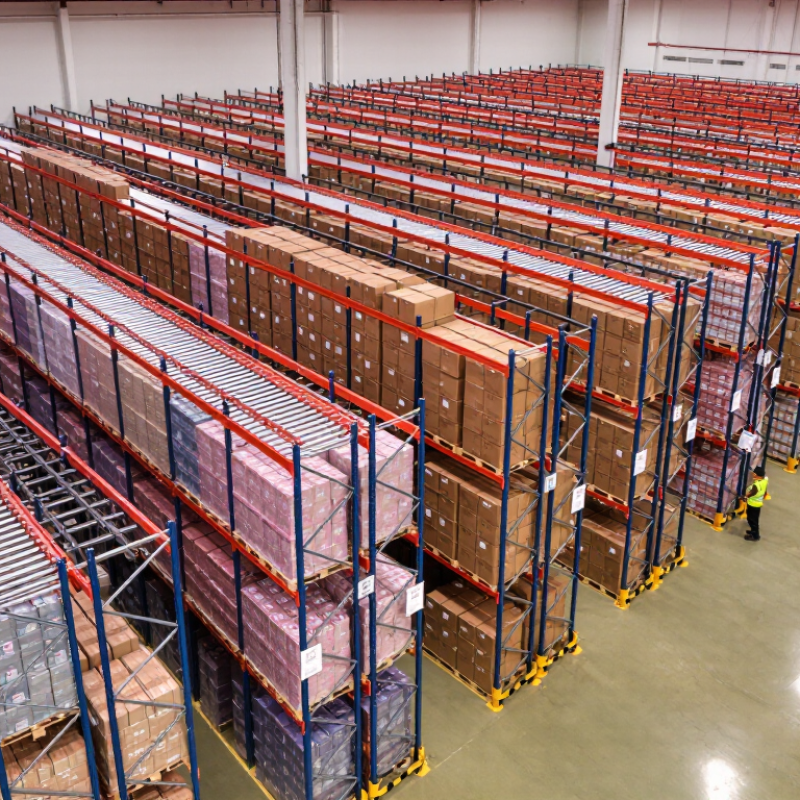
Carton flow racking is a gravity-fed storage system for cartons, totes, or small cases. It uses inclined roller lanes, a loading face, and a separate picking face. Workers load products from the rear and pick them from the front. Each lane usually includes side frames, rollers, guide rails, and a stop. Simple structure. The roller pitch must match carton size and bottom stiffness. Otherwise, containers may stall, tilt, or accelerate unexpectedly.

A 2024 material-handling industry report recorded cloud-computing use at 55% among surveyed supply-chain organizations. This reflects a wider move toward connected inventory control. The 2023 Global Parcel Shipping Index estimated 161.8 billion parcels worldwide in 2022. Such volume increases pressure on fast, repeatable carton picking. Flow racking helps by shortening walking distances and presenting older stock first. Its first-in, first-out behavior is useful for dated products.

The operating principle is direct. An operator replenishes from the back. Gravity moves each carton toward the picking face. A separator or brake roller controls forward motion. Pickers remove the front carton, and the next carton advances automatically. Lane labels should show SKU, quantity, and replenishment limits. In practice, the design is not flawless. Dust, damaged cartons, and uneven loads can reduce flow. Some lanes still need manual adjustment. Testing with real carton samples remains more reliable than relying only on drawings or theoretical load data.

Seven Leading Carton Flow Racking System Types for Global Buyers

Global buyers need more than a standard rack drawing. Seven leading carton flow racking system types include roller-track flow, skate-wheel flow, ball-wheel flow, full-width lanes, split-lane configurations, pick-to-light flow, and mobile carton flow modules. Roller tracks suit heavier cartons and steady replenishment. Skate wheels reduce starting resistance for lightweight packages. Ball-wheel decks handle mixed carton sizes. Full-width lanes simplify loading, while split lanes improve SKU density. Pick-to-light integration can reduce search time in fast-moving zones. Mobile modules preserve floor space but require stronger planning and maintenance.

The MHI Annual Industry Report 2024 found that 55% of surveyed supply-chain leaders planned to increase technology investment. That figure supports evaluating flow racks as part of a wider material-handling plan. Measure carton weight, base quality, daily order lines, lane depth, and replenishment frequency before selecting a system. Small cartons may stall on poorly spaced rollers. Heavy cartons may deform weaker shelves. Real warehouse trials matter.

There is no universal winner. Not even close. Global buyers should also check load ratings, corrosion protection, spare-part access, and operator training. A split-lane design may improve density, yet create replenishment errors if labels are unclear. Mobile flow modules save space, but their moving components deserve careful inspection. The 2024 Global Warehouse Automation Market Review reported continued investment in scalable automation, although forecasts vary by region and methodology. Buyers should challenge every projection against local labor costs, carton standards, and service capability.

Key Features, Load Ratings, and Compatibility Factors

7 Best Carton Flow Racking Systems for Global Buyers

Load ratings should guide every carton flow selection. The seven practical formats include skate-wheel lanes, gravity rollers, full-width rollers, adjustable lanes, carton-flow decks, pick modules, and hybrid pallet-flow bays. Each supports different carton weights, dimensions, and replenishment speeds. Published capacity is not universal. It depends on lane length, wheel spacing, frame connections, and load distribution. A 15-kilogram carton may travel smoothly on one deck but stall on another.

Check the details. The MHI 2024 Annual Industry Report states that 36% of surveyed supply chain organizations currently use robotics and automation, while another 37% planned adoption within two years. This trend increases the need for predictable carton movement and stable rack interfaces. Buyers should confirm static and dynamic ratings separately. They should also request test evidence, deflection limits, and installation tolerances. ANSI MH16.1, EN 15635, and applicable seismic codes may affect regional approval. Local engineering review remains necessary.

Compatibility is more than matching a carton to a lane. Measure carton height, base stiffness, surface friction, barcode position, and replenishment direction. Confirm compatibility with pallet rack frames, automated equipment, fire protection, and aisle clearances. Roller lanes suit heavier cartons. Wheel decks can reduce resistance for lighter packages. Adjustable dividers handle changing stock, but they may reduce usable width. A clean spreadsheet can still mislead. Trial loading often exposes problems, especially with soft cartons, uneven bases, or mixed-case inventory. Cite: MHI, 2024 Annual Industry Report.

7 Best Carton Flow Racking Systems for Global Buyers - Key Features, Load Ratings, and Compatibility Factors
System Type Operating Principle Typical Load Rating Key Features Carton and SKU Compatibility Rack and Facility Compatibility Best-Fit Applications
1. Gravity Carton Flow Rack
Cartons are loaded from the replenishment side and move by gravity on rollers or wheel beds toward the picking face. Typical lane load: 100–500 kg
Common shelf levels: 150–600 kg per level
FIFO order, high picking density, adjustable lane dividers, front access, and relatively low energy use. Works well with rigid cartons and totes weighing approximately 3–35 kg. Carton bottoms should be flat, stable, and strong enough to roll without deformation. Compatible with boltless shelving, structural shelving, and selective pallet-rack frames when beam spacing and lane depth are suitable. Typical roller-bed slope is about 3–6%. Fast-moving spare parts, grocery items, packaged goods, e-commerce order picking, and small-item distribution.
2. Carton Flow Shelving with Roller Tracks
Individual carton lanes are built into shelving bays, with roller tracks supporting manual replenishment and picking. Typical shelf load: 100–350 kg
Typical lane load: 50–250 kg
Compact design, easy lane adjustment, modular components, low installation complexity, and good visibility of SKU labels. Suitable for small and medium cartons, plastic totes, bins, and cases with consistent dimensions. Very soft, irregular, or undersized packages may require guide rails or a flat deck. Fits manual shelving and light-duty rack structures. Verify upright spacing, shelf deflection, bay width, and the track’s minimum carton size before purchase. Retail backrooms, parts rooms, service centers, healthcare supplies, and low-to-medium volume order fulfillment.
3. Pallet-Rack-Mounted Carton Flow Modules
Carton-flow lanes are installed between pallet-rack beams, creating carton picking levels within an existing rack layout. Typical module load: 300–1,000 kg
Rack-beam capacity must be checked separately
Makes use of existing rack infrastructure, supports multiple carton levels, allows pallet reserve storage above, and can be configured for one- or two-sided picking. Suitable for cartons and totes generally ranging from 3–35 kg per unit. Lane width, roller pitch, and divider position should match the carton footprint. Requires compatible beam profiles, correct beam-to-beam dimensions, adequate rear clearance, and approved attachment methods. The rack frame and beams must be rated for the combined module and inventory load. Distribution centers requiring a combination of reserve pallet storage and high-density piece or case picking.
4. FIFO Dynamic Carton Flow Rack
Separate loading and picking faces maintain first-in, first-out inventory rotation as cartons travel through gravity lanes. Typical lane load: 150–600 kg
Heavy-duty designs may reach approximately 1,000 kg per lane
Strong stock rotation, reduced product aging, controlled replenishment, lane dividers, brake rollers, and adjustable flow-control devices. Best for date-sensitive or batch-controlled cartons with stable bases. Carton weight should be sufficient to overcome rolling resistance but not exceed the roller or brake capacity. Can be integrated with pallet racks, carton-flow frames, and pick modules. Requires accurate lane slope, suitable roller spacing, and protection against impact at the pick face. Food and beverage distribution, pharmaceuticals, cosmetics, and products requiring lot or expiry-date rotation.
5. Heavy-Duty Case Flow Rack
Reinforced rollers, structural frames, and higher-capacity lanes move heavier cases or multiple cartons through gravity flow. Typical lane load: 500–1,500 kg
Typical carton load: 15–80 kg
Higher load capacity, reinforced supports, larger rollers, replaceable components, impact protection, and optional brake or speed-control rollers. Appropriate for dense cases, industrial parts, beverage cartons, and heavier totes. Package dimensions should be consistent enough to prevent bridging or skewing. Usually installed in heavy-duty pallet-rack structures or dedicated frames. Floor slab capacity, beam deflection, rack anchoring, seismic requirements, and aisle clearance should be verified. Industrial distribution, beverage handling, automotive components, durable goods, and high-volume case picking.
6. Multi-Tier Carton Flow Pick Module
Several carton-flow picking levels are connected by stairs, lifts, or conveyors to increase vertical storage and manual picking capacity. Typical level load: 300–1,000 kg
Typical lane load: 100–600 kg
High SKU density, dedicated pick faces, replenishment from reserve levels, ergonomic shelf heights, and optional conveyor integration. Supports small cartons, totes, cases, and mixed SKU profiles when lane widths and shelf heights are adjustable. Fast-moving items should be positioned at ergonomic pick heights. Requires a coordinated design for rack frames, platforms, stairs, guardrails, fire protection, lighting, emergency access, and local building-code compliance. E-commerce fulfillment, apparel accessories, electronics parts, healthcare distribution, and operations with many active SKUs.
7. Mobile or High-Density Carton Flow Rack
Carton-flow bays are mounted on mobile bases or compact high-density structures, opening only the aisle required for picking or replenishment. Typical bay load: 500–2,000 kg
Typical lane load: 150–700 kg
High space utilization, reduced fixed aisle area, lockable mobile bases, controlled access, and improved storage density compared with static shelving. Suitable for stable cartons, totes, and case inventory with moderate picking frequency. Very high-throughput operations may require dedicated fixed pick faces to avoid aisle-opening delays. Requires a level and structurally suitable floor, adequate floor loading, electrical or mechanical drive compatibility, safety sensors, anti-tip provisions, and sufficient ceiling clearance. Cold storage, high-value inventory, archive and spare-parts storage, and facilities where floor space is more constrained than labor.
Load ratings shown are typical planning ranges rather than universal certified capacities. Final ratings must be confirmed by the system designer or manufacturer using the actual carton dimensions, load distribution, beam and upright specifications, floor conditions, seismic requirements, operating method, and applicable local standards.

How to Compare Suppliers, Costs, and International Shipping Requirements

7 Best Carton Flow Racking Systems for Global Buyers

The best seven systems usually include roller-bed, wheel-bed, FIFO, gravity-flow, pick-module, mobile, and hybrid designs. Each suits different carton sizes, order volumes, and warehouse layouts. Compare suppliers through load tests, material specifications, warranty terms, and installation records. Ask for drawings showing beam spacing, lane depth, and replenishment access. A reliable supplier should explain limitations clearly. Avoid vague promises about universal compatibility.

Request a complete cost breakdown before choosing. Include rack frames, flow lanes, guides, brakes, safety accessories, packaging, inland transport, and installation support. A low quotation can hide missing components. I have seen buyers overlook replacement rollers and later face expensive downtime. Test the slope. Cartons should move smoothly without colliding or stopping halfway. Require sample testing with your actual carton dimensions and weights.

International shipping adds another comparison layer. Confirm packed dimensions, total shipment weight, loading plans, and export documentation. Check the proposed Incoterm carefully, because responsibility changes between seller and buyer. Verify customs classification and destination requirements with a qualified logistics professional. Ask whether parts ship assembled or knocked down. Knocked-down units may reduce freight volume, but they require more labor onsite. Measure twice. One inaccurate warehouse height can delay a full container. Supplier references from similar climates and storage conditions provide useful evidence, although references are not proof of perfect performance. Build a contingency allowance into the budget. Real projects rarely match the first spreadsheet.

Safety Standards, Maintenance Needs, and Warehouse Applications

Selecting among seven carton and pallet flow options requires more than checking capacity. Safety standards must match the installation country and warehouse risk profile. EN 15635 recommends expert racking inspections at least every 12 months. Daily visual checks remain essential. That interval is not a substitute for operator attention.

OSHA estimates that powered industrial trucks cause about 85 fatal accidents and 34,900 serious injuries annually. HSE reports that lift trucks contribute to around one-quarter of workplace transport deaths in Great Britain. These figures make aisle separation, impact protection, load labeling, and trained driving critical. Carton flow racks suit fast-moving picking areas, while pallet flow systems support high-volume FIFO storage. Push-back and drive-in designs save space, but they demand stricter loading discipline.

Maintenance details often decide whether a system performs safely. Inspect rollers, wheel brakes, guides, anchors, beams, and frame alignment. Replace damaged parts; do not straighten them casually on site. Dust can slow rollers. Uneven cartons can create hidden pressure. I have seen layouts that looked efficient but forced awkward lifting at the end position. That deserves honest review. Temperature, humidity, pallet quality, and local fire rules also affect the best choice. MHI’s 2024 Annual Industry Report highlights continuing pressure to improve warehouse productivity and resilience, yet speed should never replace inspection records, clear training, and controlled access around moving equipment.

7 Best Carton Flow Racking Systems for Global Buyers

Comparison of common carton flow configurations by typical warehouse application fit. All systems use gravity-fed lanes; FIFO suitability depends on lane design, replenishment access, and load compatibility.

Reading the chart: Higher scores indicate stronger suitability for the listed warehouse requirement. Final selection should also consider carton dimensions, load weight, replenishment method, fire protection, rack inspection procedures, and local safety regulations.

Back To Top