Choosing the best Neodymium Magnet manufacturer in China is not as simple as comparing prices or reading a polished product page. A magnet may look identical in a photograph, yet differ in magnetic strength, coating quality, dimensional accuracy, and performance in heat. Small details matter. A rough edge or inconsistent coating can become a real problem during assembly.
This guide examines the practical evidence buyers can use to compare suppliers. It considers manufacturing experience, quality-control procedures, material specifications, customization, communication, and delivery reliability. Useful checks include reviewing test reports, confirming tolerances, and asking how a supplier manages batch consistency. When possible, request samples and compare them under the conditions your application will face. No single manufacturer is best for every project. A supplier suited to a high-volume industrial order may not be the right choice for a small, specialized component. Even a detailed report has limits; specifications should be checked against your own requirements. The goal is not to crown a winner based on claims alone, but to help you ask better questions and verify the answers before committing.
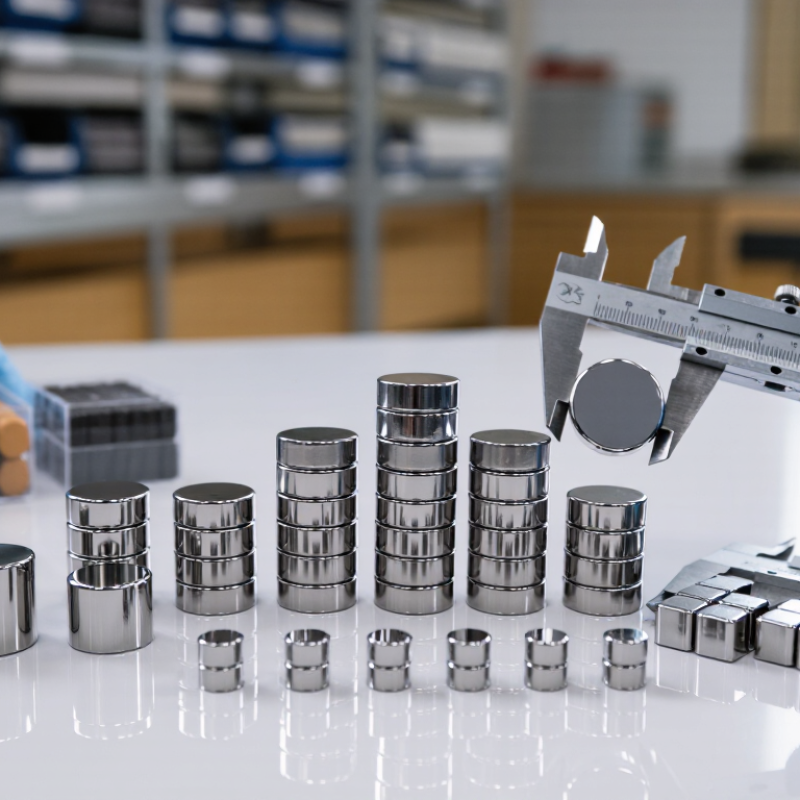
China’s role in neodymium magnet production begins with a concentrated rare-earth supply chain. The USGS Mineral Commodity Summaries 2025 estimated China mined 270,000 metric tons of rare-earth oxides in 2024, out of 390,000 worldwide. These figures describe mine production, not finished magnets. That distinction matters. The International Energy Agency’s Global Critical Minerals Outlook 2024 estimated China produced about 94% of sintered permanent magnets in 2022. Mining is only one link; refining and manufacturing capacity also shape supply.
Neodymium-iron-boron magnets require more than rare-earth feedstock. Production can involve alloying, powder processing, pressing, sintering, machining, and protective coating. Each step affects performance. A magnet with a high energy product may still be unsuitable if its temperature rating, dimensions, or corrosion resistance do not fit the application. Small coating defects can matter in humid or salty environments.
For buyers assessing a Chinese manufacturer, request test reports tied to the ordered grade and batch. Check dimensional tolerances, coating thickness, and magnetic properties, not just the catalogue value. Ask how production lots are traced and how failures are handled. A datasheet alone is weak evidence. I would also compare samples under actual operating conditions; lab figures do not capture every assembly or temperature cycle.
Choosing a Chinese neodymium magnet manufacturer requires more than comparing prices. The IEA’s Global Critical Minerals Outlook 2024 puts China’s share of global rare-earth refining at about 90% in 2023. That industrial scale is relevant, but it does not prove that an individual factory delivers consistent magnets. Scale is not proof. Ask how the supplier controls alloy composition, pressing, sintering, coating, and final inspection.
Request lot-specific test reports and confirm that results match your application. Compare magnetic grade, dimensions, tolerances, and coating thickness against your drawing. Ask which test methods and acceptance limits the factory uses, and whether samples come from regular production. A polished sample may not reflect a full production run. Check how the supplier handles rejected lots and tracks changes to materials or processes. An ISO 9001 certificate can indicate documented quality procedures, but it cannot replace product-level evidence. Also review realistic lead times and packaging details; chipped edges can complicate assembly.
Tips: Request a small pilot batch before placing a large order. Keep the drawing, test limits, and approved sample together. If a specification is vague, pause and clarify it. I would not treat the cheapest quote as the safest choice.
Choosing a neodymium magnet manufacturer in China takes more than comparing prices. The USGS Mineral Commodity Summaries 2024 estimates China produced 240,000 of the world’s 350,000 metric tons of rare-earth mine output in 2023. That figure describes upstream materials, not finished magnets. Still, it shows why buyers should check how suppliers manage material traceability and supply continuity.
Product quality should be verified with test records, not a polished brochure. Ask for Br, Hcj, and maximum energy product (BHmax) results, plus dimensional and coating checks for the exact grade. For a motor magnet, request demagnetization curves at the intended operating temperature. A sample that performs well at room temperature may disappoint in a hot housing. ISO 9001 certification can indicate a documented quality system, but it does not prove each batch meets your specification. Check whether reports identify the tested lot and calibrated equipment.
Production capacity means reliable, repeatable output—not just a large factory floor. Ask for monthly capacity by grade, typical lead times, batch yield, and contingency plans for tooling or material delays. Automotive projects may also require IATF 16949 quality-system certification; verify its scope and current validity. IEC 60404-8-1 provides a useful reference for permanent-magnet material specifications. A small caveat: paperwork can look complete while process control remains uneven. Audit a production run, compare several batches, and inspect actual parts for chipped edges, uneven plating, and dimensional drift.
The grade number indicates the magnet’s nominal maximum energy product (BHmax) in megagauss-oersteds (MGOe). Higher values indicate greater magnetic energy product, but do not by themselves establish overall product quality or identify the best manufacturer. Verify supplier-specific test results, certifications, and production capacity separately.
Choosing a Chinese neodymium magnet manufacturer is not only a price comparison. Customization and support become visible in drawings, samples, and the first production run.
The International Energy Agency’s Global Critical Minerals Outlook 2024 estimates that China makes about 94% of the world’s sintered permanent magnets. That concentration offers buyers broad technical capacity, but it does not guarantee attentive service. Ask for a written review of grade, coating, tolerances, magnetization direction, operating temperature, and corrosion exposure. Small details matter. A countersunk hole can weaken a thin magnet, while a coating suitable for one setting may fail in a humid assembly.
Support is easiest to assess before tooling begins. Request a dimensioned sample, material certificate, and test data tied to the agreed specification. USGS Mineral Commodity Summaries 2025 estimates China mined 270,000 tonnes of rare-earth oxides in 2024. Global output was 390,000 tonnes. Scale is clear. Service quality is not. See whether engineers flag unrealistic tolerances, explain sample failures, and document design changes. Some buyers accept vague promises because the quote is cheaper. I would not. Still, response speed alone can mislead: an engineer may need time to verify a design, and that pause can prevent a costly batch.
Who Is the Best Neodymium Magnet Manufacturer in China?
The best manufacturer is the one that can reliably meet your application’s demands, not simply offer the lowest price. Start with the working conditions: required pull force, operating temperature, corrosion exposure, and available space. A magnet used near a motor may need different temperature performance from one holding a cabinet door. Fit matters more.
Ask for a datasheet with grade, coating, dimensional tolerance, and magnetic properties. Then confirm how each production batch is tested and traceable. The International Energy Agency’s Global Critical Minerals Outlook 2024 reports that China produces roughly 94% of the world’s sintered permanent magnets. That concentration makes supplier checks especially useful; it does not prove that any individual factory meets your quality needs. Request sample parts and compare measurements with your drawing. If possible, review quality records or arrange an independent inspection. A low-cost sample can still hide inconsistent batch performance.
Tips: Send the manufacturer a clear drawing and operating-temperature range. Ask how test results are recorded. Check samples before approving a larger order. Even careful checks have limits. Revisit your assumptions when the magnet’s real-world environment differs from the test setup.
| Application or Requirement | Relevant Magnet Specification | Practical Selection Guidance | What to Confirm with a Manufacturer |
|---|---|---|---|
| Compact design requiring high magnetic output | NdFeB grades such as N42, N48, or N52; typical maximum energy products are approximately 40–43, 46–49, and 50–53 MGOe, respectively. | Higher grades can provide greater magnetic output for a given magnet volume, but the best grade depends on the magnetic circuit, dimensions, and operating conditions. | Request grade-specific data sheets and confirm the required flux, pull force, or field strength in the actual assembly. |
| Operation at elevated temperatures | Temperature-rated series commonly include M, H, SH, UH, and EH; typical maximum operating-temperature references are about 100°C, 120°C, 150°C, 180°C, and 200°C, respectively. | Choose a temperature rating above the expected working temperature. Heat resistance also depends on the magnet’s dimensions, magnetic load line, and application design. | Confirm the grade’s temperature limits and request performance data at the application’s actual operating temperature. |
| Motors, generators, and sensors | Grade, magnetization direction, pole pattern, shape, and dimensional consistency. | For assemblies with a defined magnetic circuit, specify the required field or flux rather than selecting by grade number alone. | Confirm magnetization direction, polarity, drawing tolerances, inspection method, and sample-approval process. |
| Indoor use in a dry environment | Protective coating such as nickel-copper-nickel, zinc, or epoxy. | Coating choice should reflect handling, appearance, and exposure conditions. Coatings can be damaged by impact or abrasion. | Specify the coating system, coverage requirements, and any applicable adhesion or corrosion tests. |
| Humid, corrosive, or outdoor exposure | Corrosion-resistant coating and, where needed, a suitable sealed assembly design. | NdFeB magnets can corrode if their protective coating is damaged or unsuitable for the environment. No coating should be assumed suitable for every exposure. | Provide the expected environment and agree on a test method and acceptance criteria; request coating and corrosion-test documentation. |
| Custom shapes or tight assembly fit | Custom geometry, machining or grinding requirements, and drawing-defined tolerances. | Feasibility and achievable tolerances depend on shape, size, process, and coating. Final dimensions should account for the coating where relevant. | Request a drawing review, tolerance capability confirmation, first-article inspection, and dimensional reports for critical features. |
| Repeat production and consistent quality | Documented quality system, lot traceability, and defined inspection plan. | A quality-system certificate can support process control, but it does not by itself prove that a magnet meets a specific application’s requirements. | Ask about lot identification, incoming and final inspection, nonconformance handling, and sample-to-production consistency. |
| Regulatory or material-compliance requirements | Applicable declarations and test documents for the finished part and its coating. | Requirements vary by market, product, and end use; request documents that match the specific shipment and applicable regulations. | Confirm the required declarations or reports, their scope, validity, and whether they cover the magnet, coating, and packaging as applicable. |
| Supplier comparison and final selection | Technical fit, validated samples, production capability, lead time, and total landed cost. | The best manufacturer is the one that can consistently meet the application’s verified technical, quality, delivery, and compliance requirements. | Compare written specifications, sample-test results, quality records, delivery commitments, packaging, and commercial terms. |
| Specifications and temperature references are general selection guidance. Actual performance depends on the magnet grade, dimensions, magnetization, magnetic circuit, coating, and operating conditions; verify all critical requirements with application-specific data and testing. | |||