
How to Choose the Right AGV Technology for Your Business
Choosing the right Agv Technology begins with your actual workflow, not with the newest vehicle on a supplier’s brochure. A warehouse moving pallets across smooth concrete needs different equipment from a factory carrying small parts between crowded workstations. The difference matters.
Joseph F. Engel, a recognized pioneer of automated guided vehicles, offered a useful principle: “An AGV is a system, not simply a vehicle.” That view remains practical today. A successful project connects vehicles, navigation, charging, fleet management, warehouse software, and trained employees. Ignoring one part can weaken the entire operation.
Begin by measuring the work. Record payload weight, travel distance, aisle width, floor condition, traffic patterns, and delivery frequency. Watch the process during busy shifts. Quiet periods can hide the real problem. Then compare magnetic guidance, laser navigation, vision systems, and natural-feature navigation. Each option has strengths. Each also has limitations.
Safety deserves more than a checklist. People step into routes. Pallets shift. Sensors become dirty. Good Agv Technology must respond safely to these ordinary events. Ask suppliers for tested stopping distances, maintenance requirements, integration examples, and measurable performance data.
Cost also needs a wider definition. Purchase price is only one part. Include installation, software, batteries, charging infrastructure, training, downtime, and future expansion. A cheaper vehicle may create expensive bottlenecks. That assumption is sometimes wrong, though. A complex system can also be unnecessary.
The best choice fits your operation today while allowing careful growth tomorrow. It should solve a visible problem, support reliable work, and remain understandable to the people using it. Performance is important. Practicality is harder to replace.
Understanding AGV Technology and Its Role in Business Operations
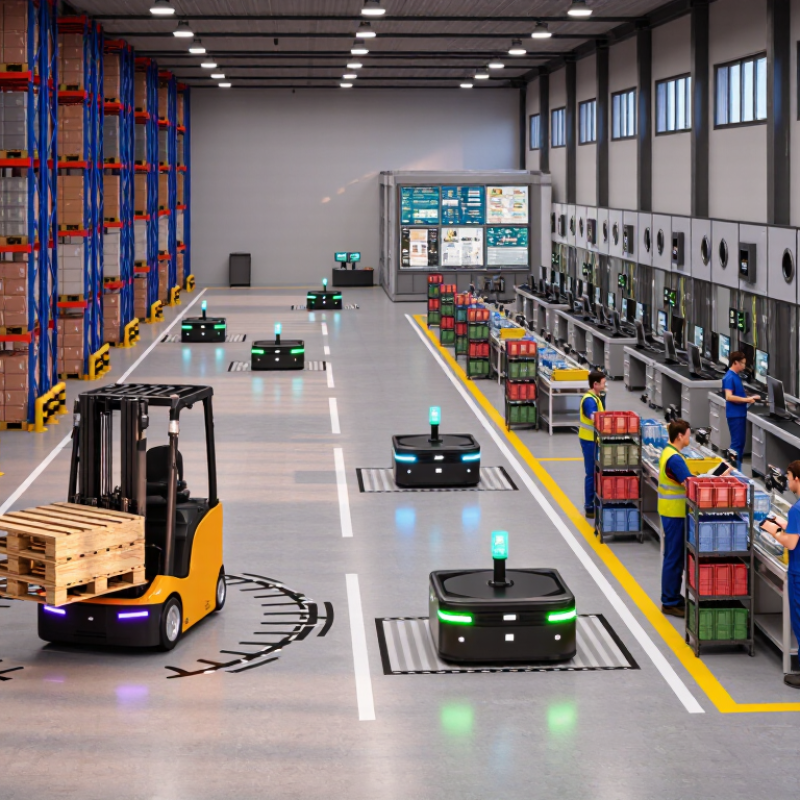
Choosing AGV technology starts with understanding its operational role, not comparing navigation systems. An AGV moves materials between defined points, protects production flow, and reduces repetitive travel. In a warehouse, it may carry totes from receiving to storage with fewer empty trips. The International Federation of Robotics reported 541,302 industrial robots installed worldwide in 2023. That figure excludes AGVs, but it reflects wider industrial demand for automation.
MHI’s 2024 Annual Industry Report found that 55% of surveyed supply-chain professionals already use robotics and automation. This adoption pressure can make AGVs attractive, but the technology must match real constraints. Use guided vehicles where routes remain stable and floor markers stay reliable. Consider flexible navigation where layouts change frequently. Check payload, turning radius, lift height, battery charging, traffic rules, and software interfaces. Small details matter. A vehicle that fits an aisle may still restrict emergency access. Site tests should measure cycle time, congestion, charging downtime, and operator interaction. Do not trust speed alone.
A practical business case combines labor hours, throughput, maintenance, integration, and safety controls. It should include failure recovery: who clears a stalled vehicle at 2 a.m.? That question is uncomfortable. Pilot one route with real loads and imperfect conditions, including dust, uneven pallets, and peak traffic. Compare baseline data before scaling. I would challenge any forecast promising immediate payback. Integration costs, mapping changes, and training are easy to underestimate. The right AGV decision depends on evidence collected inside the actual operation.
How to Choose the Right AGV Technology for Your Business - Understanding AGV Technology and Its Role in Business Operations
| AGV Technology | Typical Payload | Typical Operating Speed | Navigation Method | Best-Fit Operations | Infrastructure Requirements | Key Advantages | Primary Limitations | Implementation Complexity |
|---|---|---|---|---|---|---|---|---|
| Laser-Guided AGV | 500–5,000 kg | 0.8–2.0 m/s | Reflectors, mapped reference points, or natural-feature laser navigation | High-volume material movement between production, storage, and shipping areas | Clear travel lanes, mapped routes, safety zones, and reliable localization features | Accurate navigation, repeatable routes, and strong suitability for large facilities | Higher installation effort; route changes may require system remapping or reconfiguration | Medium to high |
| Magnetic-Tape or Wire-Guided AGV | 500–3,000 kg | 0.5–1.5 m/s | Magnetic tape, embedded wire, or other fixed guidance paths | Stable, repetitive routes in manufacturing and warehouse environments | Installed tape or floor wire, defined intersections, and maintained routes | Straightforward deployment, predictable movement, and relatively low navigation cost | Limited flexibility; floor damage, contamination, or layout changes can affect guidance | Low to medium |
| Unit-Load AGV | 250–2,000 kg | 0.8–1.8 m/s | Laser, magnetic, QR-code, or natural-feature navigation | Pallets, totes, cartons, and containers moved between fixed workstations | Transfer stations, defined pickup and drop-off points, and warehouse-management integration | Efficient horizontal transport and consistent delivery timing | Usually requires standardized load dimensions and accurately positioned stations | Medium |
| Towing AGV | 1,000–10,000 kg total train load | 0.8–1.5 m/s | Laser, magnetic, wire-guided, or mapped navigation | Milk-run logistics, line feeding, and repeated movement of multiple carts | Turning clearance, cart coupling points, route controls, and adequate aisle width | Moves several loads per trip and can reduce forklift traffic in production areas | Longer stopping distance, larger turning radius, and reduced suitability for congested aisles | Medium |
| Forklift AGV | 1,000–3,000 kg | 0.8–1.5 m/s | Laser, vision, magnetic, or natural-feature navigation | Pallet storage, warehouse transfers, loading areas, and repetitive lift operations | Pallet-accessible aisles, rack compatibility, accurate pickup locations, and safety controls | Automates pallet handling and reduces exposure to repetitive forklift tasks | Requires strict aisle management, pallet consistency, and comprehensive safety validation | High |
| Autonomous Mobile Robot (AMR) | 50–1,500 kg | 0.5–2.0 m/s | Laser, camera, sensor fusion, and dynamic map-based navigation | Flexible order fulfillment, kitting, replenishment, and short-distance material movement | Digital facility map, network connectivity, safety zones, and defined interaction points | Flexible routing, obstacle avoidance, and easier adaptation to changing layouts | May have lower payload capacity and can be affected by congestion or poor environmental conditions | Medium to high |
Note: Payload, speed, and implementation figures are typical planning ranges. Actual performance depends on vehicle design, load dimensions, floor conditions, traffic levels, safety requirements, battery capacity, and software integration.