
China Top 24V Actuator Suppliers for Global Buyers
China Top 24V Actuator Suppliers for Global Buyers
The global actuator market is expanding with factory automation, smart buildings, medical equipment, and agricultural machinery. Grand View Research valued the global industrial automation market at approximately USD 191.9 billion in 2023. Its forecast suggests continued growth through 2030. That growth increases demand for compact, dependable, and energy-efficient Actuator 24v solutions.
Small voltage. Serious responsibility.
A 24V actuator often operates valves, lifting columns, dampers, access panels, and conveyor mechanisms. In real installations, buyers must examine stroke length, load capacity, duty cycle, ingress protection, noise, and feedback options. A polished product photograph cannot reveal thermal limits or gearbox wear. Samples and factory audits still matter.
MarketsandMarkets estimates that the linear actuator market could grow from about USD 8.1 billion in 2023 to USD 12.1 billion by 2028. Figures differ between research firms, so readers should treat forecasts as directional rather than absolute. Jim Pinto, a recognized automation strategist, defined automation as “the technology by which a process or procedure is performed with minimal human assistance.” His observation remains relevant to 24V actuator selection, where reliable motion reduces manual intervention.
China has a broad supplier base, including OEM factories, specialized motor manufacturers, and integrated motion-control companies. However, supplier capability is uneven. Some manufacturers offer strong customization but limited documentation. Others provide excellent testing but longer lead times. This guide evaluates 24V actuator suppliers through practical criteria, including engineering experience, certifications, testing records, export support, and after-sales responsiveness. No ranking is perfect. Application conditions can change the result.
What 24V Actuators Are and Why Global Buyers Choose Chinese Suppliers
China Top 24V Actuator Suppliers for Global Buyers
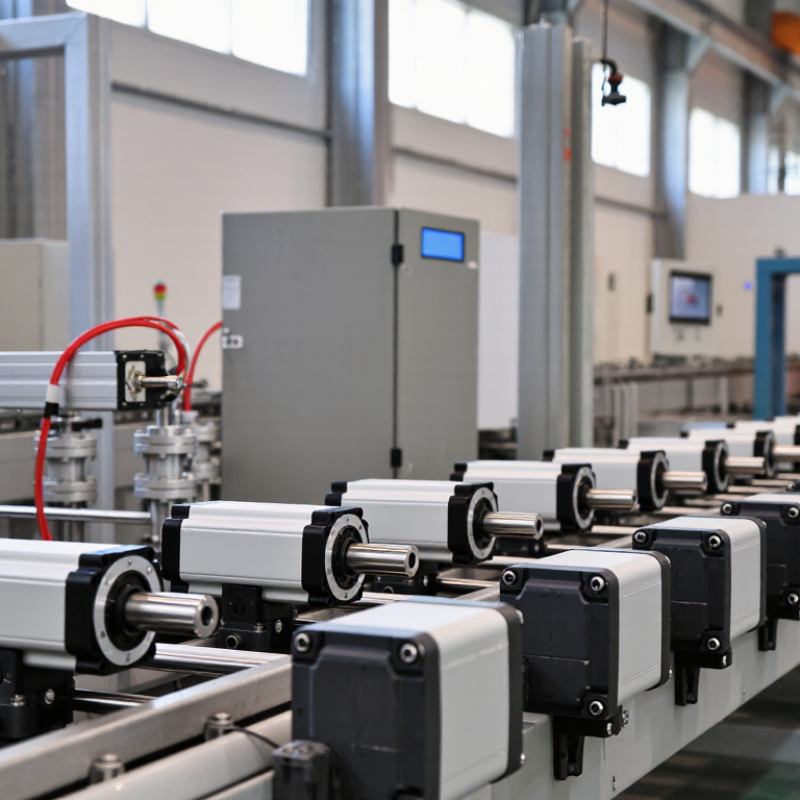
A 24V actuator converts electrical power into controlled linear movement. Inside, a motor drives gears and a screw mechanism. The output rod then pushes or pulls a load. This design supports adjustable beds, medical equipment, industrial machinery, furniture, and access systems.
Global buyers often choose Chinese suppliers because the manufacturing network is broad and responsive. Many factories can adjust stroke length, load capacity, mounting points, cable length, and control options. They also support common feedback systems, including limit switches, potentiometers, and Hall sensors. A 24V input suits many low-voltage control systems. It can simplify integration.
Practical sourcing still requires careful checking. Ask for load curves, duty-cycle limits, noise data, ingress protection ratings, and test procedures. Samples should complete repeated cycles under realistic loads. Inspect rod alignment, connector quality, and emergency stopping behavior. Do not trust a low quotation alone. Some specifications remain unclear until testing begins. That is an uncomfortable but useful lesson. Experienced suppliers usually provide drawings, inspection records, traceability details, and technical answers without delay. Independent verification remains wise, especially when the actuator will operate continuously or support sensitive equipment.
China Top 24V Actuator Suppliers for Global Buyers - What 24V Actuators Are and Why Global Buyers Choose Chinese Suppliers
A practical comparison of common 24V DC linear actuator configurations, purchasing criteria, and supplier capabilities for international buyers.
| Data Dimension | Common 24V Actuator Specification | Typical Buyer Requirement | Why It Matters in Global Sourcing | Recommended Verification |
|---|---|---|---|---|
| Actuator Definition | A 24V actuator is an electrically powered linear motion device that converts motor rotation into controlled push-and-pull movement. | Stable linear movement for lifting, positioning, tilting, opening, or adjusting equipment. | 24V DC power is widely used in mobile equipment, automation systems, furniture, medical equipment, and solar tracking systems. | Confirm the actuator type, operating voltage, motion direction, mounting method, and control interface. |
| Rated Voltage | 24V DC nominal Typical operating range: approximately 18–30V DC, depending on the product design. | Compatibility with the available battery, power supply, control box, or vehicle electrical system. | A 24V system generally allows lower current than a comparable 12V system at the same power level. | Check the manufacturer’s rated voltage, allowable voltage range, current draw, and protection against reverse polarity. |
| Load Capacity | Common product ranges include approximately 600N to 10,000N. Actual capacity depends on speed, stroke, duty cycle, and installation angle. | Required pushing or pulling force with an appropriate safety margin. | Chinese manufacturers commonly offer multiple force levels and can adapt gear trains, screws, motors, and housings for different loads. | Request load-versus-speed curves, static holding capacity, dynamic load ratings, and test conditions. |
| Stroke Length | Common standard strokes range from approximately 50mm to 1,000mm; custom lengths may also be available. | Movement distance required by the mechanism or end product. | Standard stroke options can shorten development time, while customized stroke lengths support OEM and equipment integration. | Confirm nominal stroke, tolerance, retracted length, extended length, and mechanical end-stop position. |
| Operating Speed | Typical no-load speeds range from approximately 5mm/s to 100mm/s. Speed normally decreases as load increases. | A balance between positioning time, noise, load capacity, and system control accuracy. | Different screw pitches, gear ratios, and motor configurations allow suppliers to produce either high-force or high-speed models. | Compare speed at the intended working load rather than relying only on no-load speed. |
| Duty Cycle | Many compact models use intermittent duty cycles such as 10% to 25%, often expressed as short operation followed by a cooling period. | Operating frequency, runtime per cycle, rest time, and total cycles per hour. | Correct duty-cycle selection helps prevent overheating, premature wear, and motor protection trips. | Ask for the exact duty-cycle statement, ambient-temperature conditions, thermal protection method, and cycle-life test data. |
| Protection Rating | Common enclosure ratings include IP44, IP54, IP65, and IP66, depending on sealing and application design. | Resistance to dust, splashing water, outdoor exposure, or wash-down conditions. | Suppliers serving international markets often provide sealed housings, protective bellows, stainless-steel components, or corrosion-resistant finishes. | Verify whether the IP rating applies to the complete actuator, cable entry, connector, and installed orientation. |
| Limit Switches | Built-in limit switches can stop the actuator at the fully retracted and fully extended positions. | Reliable end-of-travel protection and repeatable operation. | Fixed or adjustable limit-switch designs support different equipment architectures and maintenance requirements. | Confirm whether limits are factory-set or adjustable, and whether manual override or reset functions are included. |
| Position Feedback | Available options may include potentiometers, Hall sensors, magnetic pulse feedback, or integrated position sensors. | Closed-loop positioning, synchronization of multiple actuators, or digital control. | Feedback options improve system monitoring and can support automated equipment without changing the basic 24V power architecture. | Check signal type, resolution, output range, connector pinout, zero position, and controller compatibility. |
| Control Method | Common control methods include polarity reversal, relay control, push-button control, wired controllers, and programmable control boxes. | Simple extend/retract operation or integration with PLC, CAN bus, wireless, or smart-control systems. | Suppliers can often provide actuator-and-controller packages that reduce integration work for overseas buyers. | Request wiring diagrams, current requirements, communication protocols, emergency-stop behavior, and overload protection details. |
| Typical Applications | Medical beds, adjustable furniture, agricultural machinery, vehicle equipment, industrial automation, solar tracking, and access systems. | Application-specific combinations of force, speed, stroke, noise, sealing, and feedback. | Broad manufacturing capacity enables buyers to source standard products or develop application-specific assemblies from one supply base. | Provide the supplier with load direction, mounting geometry, cycle frequency, environmental conditions, and required service life. |
| Materials and Construction | Typical components include aluminum or steel outer tubes, worm or spur gearboxes, lead screws, polymer or metal nuts, and steel mounting brackets. | Required corrosion resistance, stiffness, weight, noise level, and expected operating life. | Material and surface-treatment choices affect durability, shipping weight, cost, and suitability for indoor or outdoor use. | Confirm material grades, coating or anodizing method, fastener material, corrosion testing, and dimensional drawings. |
| Quality and Compliance | Manufacturing systems may be supported by quality-management certification and product testing for electrical safety, EMC, RoHS, or application-specific requirements. | Documentation suitable for import, internal validation, and regional market access. | International buyers typically require traceability, inspection records, consistent sampling, and documentation matched to the destination market. | Request current certificates, declarations, test reports, inspection plans, and serial-number or batch-traceability procedures. |
| Customization Capability | Possible customization areas include stroke, force, speed, mounting brackets, cable length, connectors, limit positions, feedback, and housing finish. | Fit with an existing product or a new equipment design. | OEM and ODM capability can reduce redesign costs when standard actuator dimensions do not meet the installation requirements. | Confirm engineering drawings, prototype process, tooling charges, sample lead time, minimum order quantity, and change-control procedure. |
| Buyer Evaluation Criteria | Technical fit, test evidence, production consistency, communication, lead time, packaging, warranty, and after-sales support. | A supplier able to provide repeatable quality and dependable export fulfillment. | Comparing suppliers by measurable specifications rather than price alone helps reduce integration risk and total ownership cost. | Use a documented RFQ, approve a pre-production sample, conduct incoming inspection, and define warranty and replacement terms. |