
Top 10 CNC Turning Machine Types for Global Buyers
Buying a CNC turning machine is rarely a simple capacity decision. Global buyers must compare spindle speed, chuck size, tooling systems, control software, accuracy, service support, and total ownership cost. A compact machine may suit small brass fittings, while a heavy-duty model handles steel shafts with deep cuts. The workpiece decides much of the answer.
Dr. David A. Dornfeld, a respected manufacturing researcher, described manufacturing as “the transformation of materials into useful products.” That principle remains practical today. A CNC turning machine should not be selected for impressive specifications alone. It must produce consistent parts, manage heat, reduce setup time, and remain supported after installation. Factory floors reveal details that brochures often miss. Door access matters. Chip evacuation matters. Operator training matters.
This guide examines the top 10 CNC turning machine types for global buyers. It considers common production needs, including prototypes, automotive components, medical parts, oilfield hardware, and high-volume contract manufacturing. Each machine type has strengths, limits, and suitable working conditions. Some deliver flexibility. Others prioritize speed or rigidity. A few appear economical but may require expensive options later. That is where buyers can misjudge the investment.
No ranking is perfect. Regional power standards, labor costs, material choices, and local service networks can change the decision. Buyers should verify specifications with real samples, cutting trials, and written support terms. Practical evidence matters more than polished claims. The best CNC turning machine is not always the largest or fastest. It is the machine that repeatedly fits the buyer’s parts, people, and production reality.
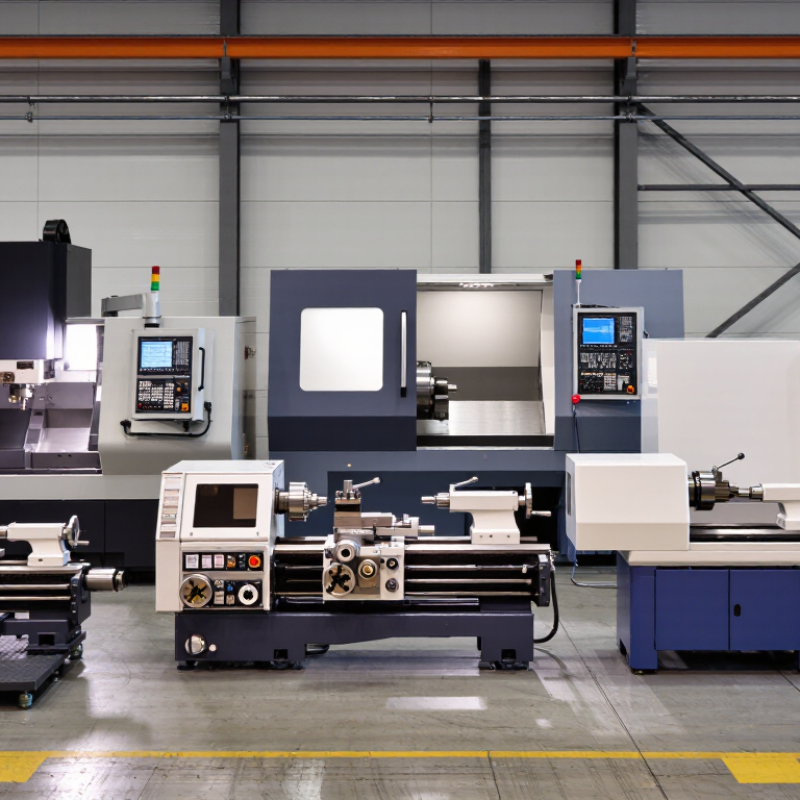
Classify the Top 10 CNC Turning Types by Axis Count and 1,000–6,000 rpm
CNC turning machines are best classified by axis count, then checked against the required spindle speed. A practical top ten includes two-axis flat-bed, two-axis slant-bed, three-axis, four-axis, live-tool, Y-axis, twin-spindle, twin-turret, Swiss-type, and five-axis turning centers. Most general turning work fits 1,000–3,000 rpm. Small bar stock often needs 3,000–6,000 rpm. Speed alone does not guarantee better parts.
Two-axis machines remain economical for shafts, bushings, and facing jobs. Three- and four-axis models add milling or off-center drilling. Y-axis and live-tool machines reduce secondary setups. Twin-spindle and twin-turret designs improve transfer work, although programming becomes less forgiving. Swiss-type machines suit slender medical and electronics components, often using higher speeds near 4,000–6,000 rpm. Five-axis turning centers handle complex geometries, but their value depends on actual production volume.
Grand View Research estimated the global CNC machine market above 80 billion dollars in 2023, reflecting broad demand across automotive, aerospace, and general machinery. MarketsandMarkets also identifies automation and multi-axis machining as major market drivers in its recent CNC machine analysis. These reports support a clear purchasing lesson: match axis count to part complexity, not showroom appearance. In my experience, a 6,000 rpm spindle can be unnecessary for heavy steel. That assumption deserves checking. Tool geometry, material, chuck balance, and cutting diameter can matter more than headline speed.
Top 10 CNC Turning Machine Types for Global Buyers - Classify the Top 10 CNC Turning Types by Axis Count and 1,000–6,000 rpm
| Rank | CNC Turning Machine Type | Typical Controlled Axes | Typical Spindle Range | Main Configuration | Typical Applications | Buyer Considerations |
|---|---|---|---|---|---|---|
| 1 | 2-Axis Flat-Bed CNC Lathe | X + Z | 1,000–3,000 rpm | Horizontal spindle with a flat guideway and standard tool turret or gang tooling. | General repair work, shafts, bushings, spacers, and small-batch cylindrical parts. | Economical and easy to maintain; usually offers less rigidity and automation than slant-bed designs. |
| 2 | 2-Axis Slant-Bed CNC Turning Center | X + Z | 2,000–4,000 rpm | Angled bed, enclosed work zone, automatic turret, and chip flow directed away from the cutting area. | Automotive components, hydraulic parts, flanges, and recurring production jobs. | A strong all-purpose choice; check chuck size, bar capacity, turret stations, and automation compatibility. |
| 3 | 2-Axis Gang-Type CNC Lathe | X + Z | 3,000–6,000 rpm | Fixed gang tooling mounted close to the spindle, generally without a conventional turret. | Small turned parts, fittings, pins, connectors, and high-volume bar-fed work. | Short tool-change times and compact footprint; tool capacity may be limited for complex parts. |
| 4 | 3-Axis CNC Turning Center with Y-Axis | X + Y + Z | 2,000–4,500 rpm | Turning spindle with live tooling and a perpendicular Y-axis for off-center machining. | Cross-holes, slots, flats, keyways, and milled features on turned components. | Can reduce secondary milling; verify Y-axis travel, live-tool torque, and toolholder standards. |
| 5 | 4-Axis CNC Turning Center with C-Axis | X + Z + C + live-tool drive | 2,000–5,000 rpm | Programmable spindle indexing or interpolation with driven tools for milling operations. | Bolt circles, radial holes, flats, keyways, and face milling on turned parts. | Offers integrated turning and milling; confirm C-axis positioning accuracy and spindle clamping performance. |
| 6 | Y-Axis Mill-Turn CNC Center | X + Y + Z + C | 2,500–6,000 rpm | Turning spindle combined with programmable Y-axis milling and C-axis contouring. | Complex valve bodies, manifolds, couplings, aerospace fittings, and precision mechanical parts. | Excellent process consolidation; higher programming, fixturing, and maintenance requirements. |
| 7 | Twin-Spindle CNC Turning Center | X1 + Z1 + X2 + Z2 | 2,000–5,000 rpm | Main spindle and secondary spindle transfer workpieces for front- and back-side machining. | Long shafts, two-ended components, automotive parts, and parts requiring complete machining. | Improves throughput and reduces manual handling; spindle synchronization and transfer setup are important. |
| 8 | Twin-Spindle CNC Mill-Turn Center | X + Y + Z + C, with a second spindle | 2,000–6,000 rpm | Dual-spindle turning with live tooling, Y-axis movement, and coordinated part transfer. | High-value parts combining turning, drilling, tapping, milling, and back-end operations. | Highly productive for complete machining; requires skilled process planning and sufficient shop-floor capacity. |
| 9 | Swiss-Type CNC Sliding-Headstock Lathe | Typically 5–7 controlled axes | 3,000–6,000 rpm | Sliding headstock, guide bushing, main and often back-working tools, with synchronized tooling. | Long, slender precision parts, medical components, miniature shafts, and electronic hardware. | Excellent support near the cutting zone; tooling, setup, and programming are more specialized. |
| 10 | Vertical CNC Turning Center | Typically 2–4 axes: X + Z, optional C or live tooling | 1,000–3,000 rpm | Vertical spindle orientation with the workpiece mounted on a horizontal rotating table or chuck. | Large-diameter rings, discs, bearing housings, brake components, and heavy workpieces. | Gravity assists loading and improves stability for large parts; floor space and workpiece height must be checked. |
| Selection note: The spindle-speed bands are representative purchasing ranges for common industrial configurations, not universal machine limits. Actual speed depends on spindle power, maximum workpiece diameter, chuck or collet capacity, material, tooling, and the manufacturer’s design. | ||||||
Related Posts
-
Top 10 CNC Turning Machines Buyers Must Consider
-

Top 10 Lathe Machine Models for Global Buyers in 2026?
-

2026 How to Choose the Best Lathe Machine for Your Workshop?
-
Top CNC Lathe Machines in 2025: Features, Benefits, and Buying Guide
-

Top 10 Benefits of Using CNC Turning Machines for Precision Manufacturing
-
Top 10 Advantages of Using a CNC Turning Machine for Precision Engineering?