Choosing the 2026 best large CNC machine requires more than comparing spindle power, table size, or purchase price. Global manufacturers now evaluate accuracy, automation readiness, energy use, service coverage, and total lifecycle cost. A 3,000-millimeter table may look impressive, but it means little without thermal stability, reliable probing, and repeatable performance across long production shifts.
Industry data shows why this decision matters. The International Federation of Robotics reported 541,302 industrial robot installations worldwide in 2023, confirming the rapid expansion of automated production. Deloitte’s 2025 Manufacturing Industry Outlook also identifies smart manufacturing, artificial intelligence, and connected equipment as major investment priorities. Meanwhile, Grand View Research continues to forecast steady growth in the global CNC machine market, although estimates differ by machine category and research method. Large-format CNC demand is harder to measure separately. That limitation deserves attention.
Peter Zelinski, editor-in-chief of Modern Machine Shop, has expressed a practical principle: “Automation is a means, not an end.” The quote fits large CNC machine selection perfectly. A high-speed five-axis system can reduce setups, yet it may create unnecessary complexity for stable three-axis work. Conversely, a slower machine with stronger service support may deliver better output in remote facilities.
This guide examines the leading 2026 options through real manufacturing priorities. Expect comparisons of work envelope, rigidity, control systems, chip evacuation, operator access, maintenance, and return on investment. No machine wins everywhere. The best choice depends on material, part size, production volume, workforce skills, and regional support.
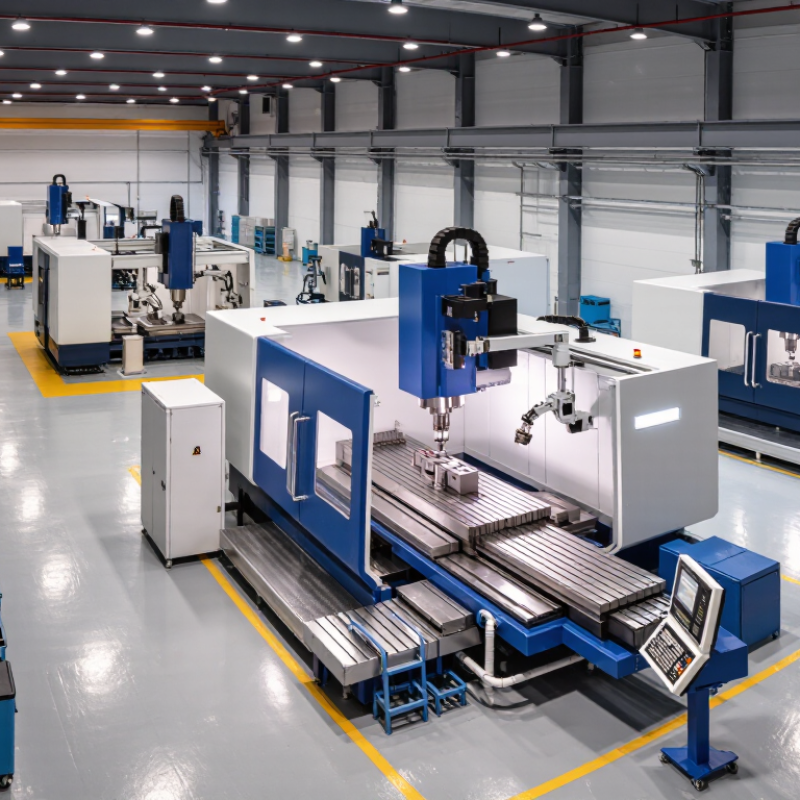
In 2026, a large CNC machine should not be defined by appearance alone.
The practical measure is its working envelope, travel distance, payload, and structural stability. A machine cutting a 2,000-millimeter aerospace panel faces different demands than one machining a heavy valve body. There is no universal size threshold. That detail is often overlooked.
The 2024 World Machine Tool Survey reported global machine-tool consumption above 80 billion U.S. dollars in 2023. This scale reflects continued investment in complex production, not simply bigger equipment.
A large CNC system usually needs extended X, Y, and Z travel, a rigid bed, high spindle torque, and controlled thermal behavior. ISO 230 testing remains important for checking positioning accuracy and repeatability. A long machine can still produce poor parts if heat, vibration, or foundation movement is ignored.
Space is only one constraint. Factory doors, floor loading, chip evacuation, coolant capacity, and operator access can decide whether installation succeeds.
The International Federation of Robotics reported more than 500,000 industrial robots installed worldwide in 2023, showing the wider shift toward connected production. Large CNC machines increasingly require probing, tool monitoring, and automated material handling.
Yet automation does not fix weak process planning. In real workshops, oversized capacity may remain unused for months. A smaller, better-matched envelope can sometimes deliver higher utilization, lower energy demand, and fewer setup errors.
Choosing the best large CNC machine in 2026 starts with the application, not table size. Three-axis mills suit structural aluminum, steel fixtures, and repeatable plate work. Five-axis machining centers handle curved aerospace structures, turbine parts, and complex medical components. Heavy-duty CNC lathes produce shafts, flanges, rollers, and hydraulic bodies. CNC routers remain useful for panels, composites, plastics, and oversized sheets. Each type solves a different production problem.
According to the International Federation of Robotics’ World Robotics 2024 report, 541,302 industrial robots were installed globally in 2023. That growth supports CNC cells with robotic loading, inspection, and pallet exchange. However, automation cannot correct poor fixturing or unstable cutting conditions. Grand View Research’s 2024 CNC machine market analysis identifies automotive, aerospace, and general machinery as major demand sectors. Global factories also need localization, spare-part access, and operators who understand process limits. That detail is easy to underestimate.
2026 Best Large CNC Machine for Global Manufacturing?
Selecting a large CNC machine begins with the part, not the machine’s advertised size. A large table is not automatically better. Start with the heaviest workpiece, its dimensions, and the space needed for fixtures. The working envelope should exceed the part by a practical margin. Tight clearances create loading problems and limit future orders. That sounds obvious.
Spindle power, torque, and speed must match the materials and cutting tools. Aluminum may need high speed, while steel often needs steady torque and rigid support. Torque matters. Check the spindle taper, tool capacity, and maximum tool weight. A long production cycle also demands stable thermal control. Small temperature changes can affect hole position and surface accuracy. In real workshops, cooling systems are sometimes treated as optional. That is a costly mistake.
Accuracy depends on the whole structure, including guideways, ball screws, calibration, and foundation quality. Ask for repeatability data under realistic loads, not only empty-table tests. Probe systems can reduce setup errors, but they cannot repair poor fixturing. The control system should support clear tool management, alarms, data records, and safe operator access. Service access deserves equal attention. Filters, lubrication points, and electrical cabinets should be reachable without dismantling major covers. I would also request a sample-cut evaluation using your own material. Published specifications rarely show every weakness. A machine may meet its figures yet feel unsuitable during daily production. That compromise deserves a written production test.
Essential Specifications for Selecting a Large CNC Machine
The chart compares representative engineering envelopes for common large-CNC configurations. Larger X, Y, and Z travels support bigger workpieces, but they also increase floor-space, rigidity, tooling, and installation requirements. For global manufacturing, verify the machine envelope against the part size, spindle power, table load, thermal stability, accuracy requirements, automation plan, and local service capability before purchasing.
Reference values are typical industry specification ranges for large machining equipment and are intended for early-stage equipment selection rather than a specific machine quotation.
2026 Best Large CNC Machine for Global Manufacturing?
For large-scale manufacturing, machine size is only one purchasing factor. Automation, software, and smart factory integration now determine usable capacity. The International Federation of Robotics reported 541,302 industrial robots installed worldwide in 2023. This signals a clear shift toward connected production cells, even though integration quality varies widely.
A strong large CNC system should support robotic loading, tool-life monitoring, remote diagnostics, and standardized data exchange. Its software must connect machine status with scheduling, quality records, energy use, and maintenance alerts. Deloitte’s 2024 Smart Manufacturing and Operations Survey found that 86% of manufacturing leaders expect smart manufacturing to become a major competitiveness driver within five years. Still, many factories underestimate data preparation. A perfect dashboard cannot repair inconsistent part numbers or incomplete downtime records. That weakness deserves attention.
Tips: Test one complete production route before expanding. Track cycle time, first-pass yield, alarm response, and operator adjustments. Require open interfaces, clear cybersecurity controls, and exportable data. The International Energy Agency reports that industrial energy efficiency remains essential for reducing global energy demand, so measure power per finished part. Do not promise fully autonomous production too early. Human judgment still matters during unusual material behavior, tool wear, or urgent design changes. A smaller pilot may reveal more than an impressive factory demonstration.
Comparative planning guide based on commonly specified capabilities for large-format CNC systems. Values are indicative ranges and should be verified against the final machine configuration, material, tooling, and production process.
| Evaluation Dimension | Large 3-Axis Gantry Mill | Large 5-Axis Gantry Mill | Large Horizontal Machining Center | Hybrid CNC Manufacturing Cell |
|---|---|---|---|---|
| Typical manufacturing role | Large plates, molds, structural parts, and long components | Complex aerospace, energy, marine, and die-mold components | Heavy prismatic parts requiring multiple-sided access | Low-volume or high-mix production with machining and additive or process operations |
| Typical work envelope | X: 2,000–12,000 mm Y: 1,000–4,000 mm Z: 800–2,000 mm |
X: 2,000–10,000 mm Y: 1,500–4,000 mm Z: 1,000–2,500 mm |
X: 1,000–3,000 mm Y: 800–1,600 mm Z: 800–1,800 mm |
X: 1,000–4,000 mm Y: 800–2,000 mm Z: 800–2,000 mm |
| Axis configuration | 3 linear axes; optional rotary table or indexer | 3 linear axes plus 2 synchronized rotary axes | 3 linear axes; pallet rotation or optional rotary axis | 3–5 machining axes with additional process or tool-management modules |
| Spindle power range | 22–75 kW | 30–100 kW | 30–110 kW | 20–80 kW for subtractive machining, depending on the process module |
| Typical spindle speed | 6,000–24,000 rpm | 8,000–30,000 rpm | 4,000–18,000 rpm | 6,000–24,000 rpm, depending on material and hybrid process |
| Positioning performance target | Approximately ±0.015–0.050 mm, configuration dependent | Approximately ±0.010–0.035 mm; rotary-axis accuracy must also be evaluated | Approximately ±0.010–0.030 mm under defined test conditions | Approximately ±0.015–0.050 mm, depending on the active process |
| Suitable materials | Aluminum, steel, cast iron, composites, plastics, and non-ferrous alloys | Aluminum, titanium, nickel alloys, steel, composites, and hardened materials with suitable tooling | Steel, cast iron, titanium, nickel alloys, and heavy engineering materials | Metals and selected composites; material range depends on the integrated process modules |
| Automatic tool management | Tool magazine commonly holds 24–120 tools; automatic measurement is recommended | Tool magazine commonly holds 40–240 tools; tool-life monitoring and collision avoidance are highly valuable | Tool magazine commonly holds 40–300 tools; pallet and tool management support long unattended cycles | Tool management integrates cutting tools, process heads, probes, and auxiliary equipment |
| Workpiece automation | Optional pallet changers, vacuum tables, probing, and robotic loading | Robotic loading, automated fixturing, probing, and multi-part workholding | Strong fit for pallet pools, pallet changers, tombstones, and automated part transfer | Integrated robot cell, material handling, inspection, and process sequencing |
| CNC software capabilities | 3-axis CAM, adaptive roughing, tool probing, simulation, and job scheduling | 5-axis tool-path control, inverse-time feed control, machine simulation, and collision checking | Multi-face programming, pallet scheduling, high-speed machining, and process monitoring | Unified CAM, additive/subtractive path planning, digital work instructions, and recipe management |
| Smart factory connectivity | Ethernet connectivity with production monitoring and basic machine data collection | Real-time machine data, tool condition data, energy monitoring, and digital twin integration | Pallet status, spindle load, downtime codes, production scheduling, and centralized dashboards | Cell-level orchestration, traceability, inspection data, robotics, and enterprise-system integration |
| Common communication standards | MTConnect, OPC UA, Ethernet-based CNC communication, and standard industrial networking | MTConnect, OPC UA, CAD/CAM data exchange, and secure factory-network protocols | MTConnect, OPC UA, machine-to-management interfaces, and scheduling-system connectivity | OPC UA, MTConnect, robot interfaces, manufacturing execution systems, and quality databases |
| Inspection and quality control | Touch probe, laser tool measurement, and optional offline coordinate inspection | On-machine probing, tool-center-point calibration, laser measurement, and closed-loop correction | In-process probing, fixture verification, tool measurement, and pallet-based inspection routines | Integrated probing, vision or metrology, automated reports, and digital quality records |
| Recommended production profile | Large parts, moderate complexity, and flexible job-shop production | Complex geometries, high accuracy, fewer setups, and premium-value components | Repeatable batch production with high material removal and multiple-sided machining | High-mix, low-volume manufacturing requiring digital traceability and process flexibility |
| Main advantages | Large capacity, straightforward programming, accessible work area, and broad material compatibility | Fewer setups, improved access to complex surfaces, and strong integration with advanced CAM | High rigidity, efficient chip evacuation, strong automation potential, and excellent repeatability | Reduced material handling, consolidated operations, improved traceability, and flexible automation |
| Key purchasing risks | Foundation requirements, thermal growth over long travels, and manual setup time | Higher programming complexity, rotary-axis calibration, and greater capital investment | Larger floor-space requirement, pallet-system complexity, and higher fixture costs | Integration complexity, software interoperability, operator training, and process validation |
Choosing the best large CNC machine for global manufacturing requires more than comparing purchase prices. A lower-cost system may demand expensive foundations, specialized installation, or frequent replacement parts. I evaluate the complete ownership cost, including shipping, training, software updates, energy use, and service travel. Ask for a five-year estimate. Numbers reveal hidden pressure.
Reliability appears in ordinary production details. During factory evaluations, I check spindle temperature, axis repeatability, chip evacuation, and control-system recovery after power loss. A machine should maintain accuracy during long shifts, not only during demonstrations.
Safety is measurable. Guarding, interlocks, emergency stops, extraction systems, and clear maintenance procedures deserve documented testing. Operators should not improvise around hazards to meet a deadline.
Worldwide support can determine whether production continues after a serious fault. Confirm regional technicians, response times, spare-part warehouses, remote diagnostics, and training in the operator’s language.
Support matters. Written service commitments are stronger than confident promises. I also recommend speaking with current users in different climates and industries. Their experience may expose vibration issues, delayed components, or difficult calibration routines.
My first comparison once focused too heavily on cutting speed. That was a mistake. A slightly slower machine with stable accuracy and dependable support may protect delivery schedules better. Global manufacturing rewards practical resilience, even when the specification sheet looks less impressive.